
As an Amazon Associate, Drillovia earns from qualifying purchases. Our recommendations are based on manufacturer-published specifications.
The drill gets the glory, but the bit does the cutting. Using the wrong bit means burnt wood, wandering holes, dulled edges, and occasionally a snapped shank. Here is what each common bit type is designed for — and which ones your drill can actually hold.
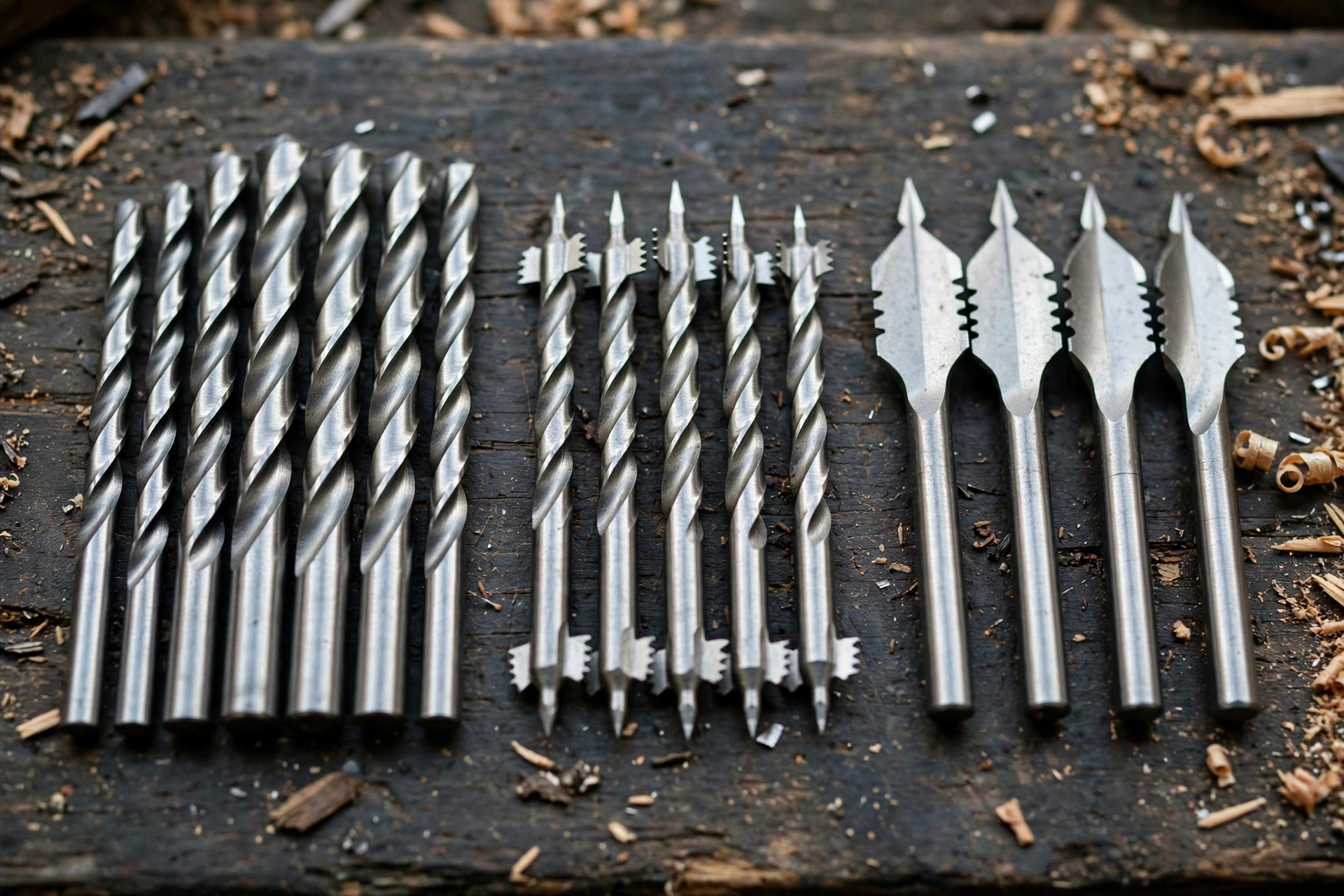
Twist Bits: The Default
The familiar spiral bit with a conical point. General-purpose twist bits (usually high-speed steel, or HSS) drill wood, plastic, and thin metal. They are the bits that come in every starter set, and they handle perhaps 70% of household drilling.
Their weakness is wandering on entry — the point skates on hard surfaces before it bites. A center punch (or even a nail dent) on metal, or starting at low speed, fixes this. For wood specifically, brad point bits are usually the better choice (below).
Brad Point Bits: For Clean Wood Holes
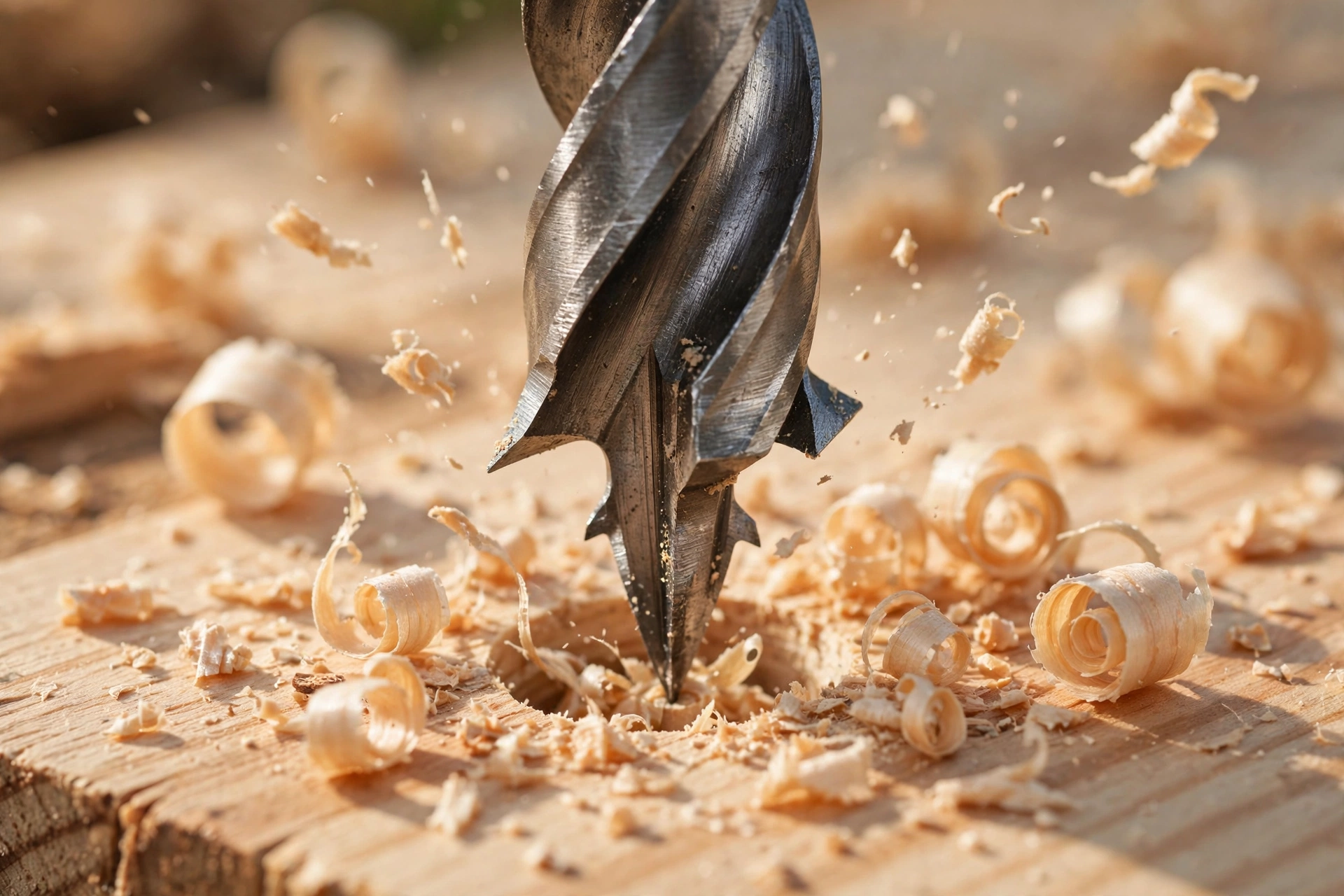
Brad point bits add a sharp center spur and two cutting spurs to the twist-bit design. The center spur anchors the bit exactly where you place it — no wandering — and the outer spurs score the wood fibers before the main cutting edges remove them. The result: clean entry holes with minimal tear-out.
If you drill wood more than occasionally — dowel joints, shelf pins, pocket holes — a brad point set is one of the highest-value upgrades you can buy. They are not for metal; the spurs dull quickly on hard material.
Spade (Paddle) Bits: Big Holes, Fast
A flat paddle with a center point and two cutting wings, spade bits bore holes from 1/4 inch up to 1-1/2 inches in wood at high speed. Electricians and plumbers live on these for running wire and pipe through studs.
The trade-off is roughness: exit holes tear out badly without a backer board. Keep the drill’s speed moderate and the bit sharp. Most spade bits have 1/4-inch hex shanks, so they work in both drills and impact drivers — check the packaging, since some budget sets use round shanks.
Forstner Bits: Flat-Bottomed Precision
Forstner bits cut flat-bottomed holes with clean sidewalls — the bit for concealed hinges, counterbore plugs, and any hole where the bottom matters. They need a drill press (or a very steady hand and low RPM) to perform well; in a hand drill, use the slowest speed and firm pressure.
They are slower and more expensive than spade bits, but there is no substitute when the hole itself is visible in the finished piece.
Hole Saws: Door Knobs and Recessed Lights
A hole saw is a toothed cylinder that cuts large-diameter circles — doorknob holes, recessed-light cutouts, dryer vents. They mount on a mandrel (arbor) with a pilot bit that keeps the saw centered while it cuts.
Two practical notes: hole saws generate a lot of friction, so clear the waste plug frequently and keep RPM low; and bi-metal hole saws cut both wood and thin metal, while carbide-grit saws are for tile and masonry-adjacent materials.
Masonry Bits: For Concrete, Brick, and Block
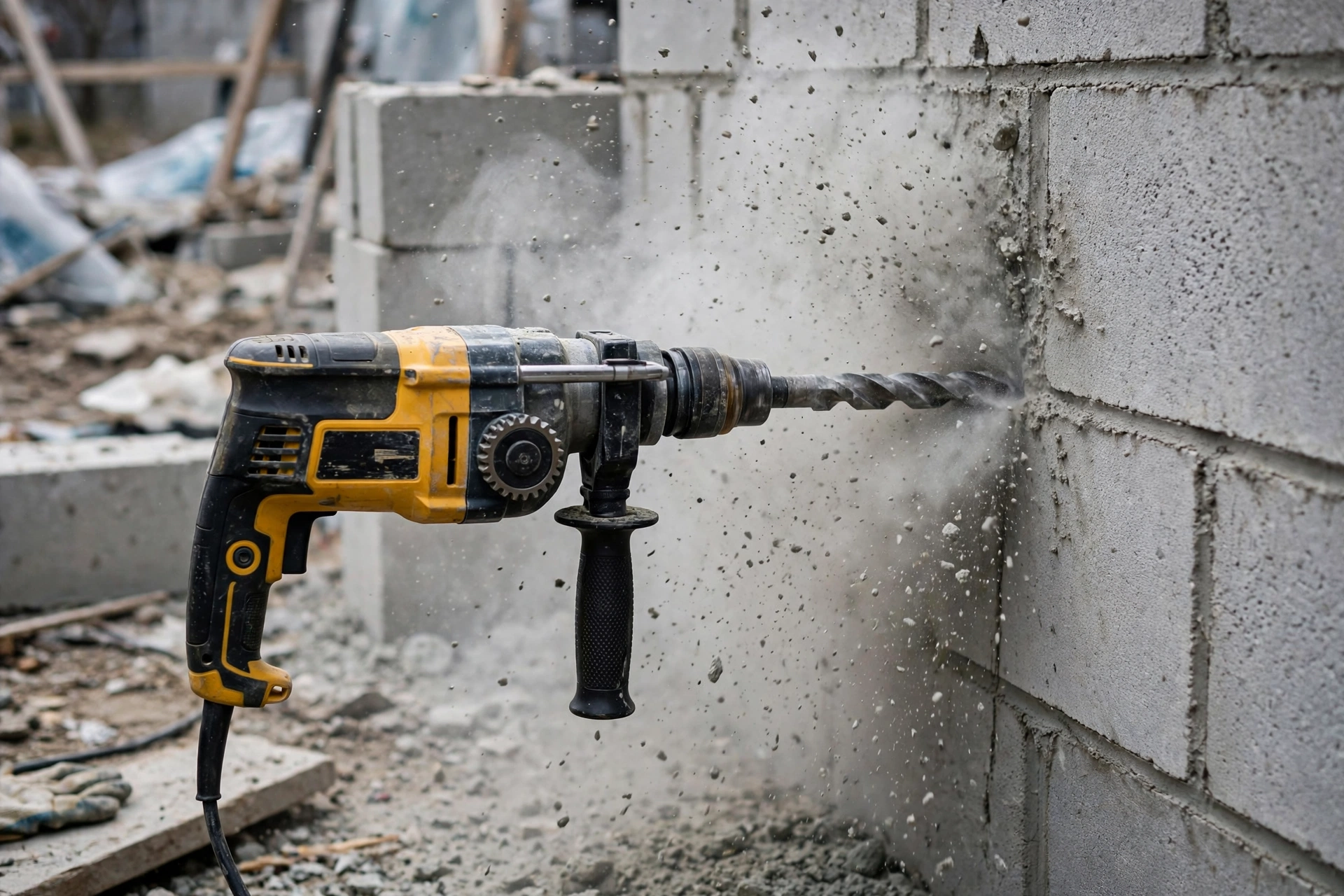
Masonry bits have a carbide tip brazed onto a steel body and a flute design that clears concrete dust. They require a hammer drill (or rotary hammer) — the axial hammering pulverizes the masonry while the flutes evacuate it. In a standard drill/driver without hammer mode, a masonry bit will barely scratch concrete.
Match the bit to the job: a standard hammer drill/driver (like the DeWalt DCD791 or Milwaukee 2904-20 class) handles holes up to about 5/8 inch in block and brick. Larger or deeper holes in poured concrete call for an SDS rotary hammer, which is a different tool category.
Step (Unibit) Bits: Sheet Metal and Thin Stock
A cone-shaped bit with graduated steps, each step a different diameter. Step bits excel in sheet metal, plastic panels, and thin plywood — one bit drills many hole sizes, and the stepped profile deburrs as it goes. They are the standard choice for enlarging existing holes cleanly.
Use cutting oil on metal and light pressure; the steps dull fast if overheated. Most step bits have 1/4-inch hex shanks.
Countersink Bits: For Flush Screws
A countersink bit cuts a conical recess so a flat-head screw sits flush with (or just below) the surface. Combination drill-countersink bits drill the pilot hole and cut the countersink in one operation — a genuine time-saver for decking, trim, and furniture work.
Bit Materials: HSS, Cobalt, Titanium, Carbide
| Material | What it is | Best for |
|---|---|---|
| High-speed steel (HSS) | Standard tool steel | Wood, plastic, mild steel |
| Cobalt (M35/M42) | HSS alloyed with cobalt | Stainless steel, hard alloys — stays hard at high heat |
| Titanium-coated | HSS with titanium nitride coating | Longer life than plain HSS in wood and mild steel; coating wears off with resharpening |
| Carbide-tipped | Carbide tip brazed to steel body | Masonry and concrete (with hammer action) |
The honest summary: plain HSS covers most household work. Step up to cobalt only when you drill stainless or hardened steel regularly. Titanium coating adds life but is not magic — a sharp HSS bit beats a dull titanium one every time.
Shank Types: Will It Fit Your Tool?
- Round shank: the standard for drill chucks (3/8 in. or 1/2 in. keyless). Fits any drill/driver.
- 1/4 in. hex shank: quick-change shank for impact drivers’ hex collets; also fits drill chucks. The fastest bit changes you will ever make.
- SDS shank: slotted shank for SDS rotary hammers only. Will not fit a standard drill chuck.
Rule of thumb: if a bit has a hex shank, it works in both your drill and your impact driver. If it has a round shank, it needs the drill’s chuck. (Not sure which tool does what? See impact driver vs drill.)
Bottom Line
Start with a quality HSS twist set and a brad point set for wood — those two cover the great majority of jobs. Add spade bits when you need big holes fast, masonry bits (plus a hammer drill) for concrete, and a step bit for sheet metal. Match the shank to your tool, keep bits sharp, and let the bit cut at its own pace rather than forcing it.
Choosing the drill itself? Our 12V vs 20V platform guide walks through picking the right voltage class, and the Drillovia drill finder matches drills to your jobs.
1 thought on “Drill Bit Types Explained: What Each Bit Is For”
Comments are closed.