
As an Amazon Associate, Drillovia earns from qualifying purchases. Our recommendations are based on manufacturer-published specifications.
The voltage number on a cordless drill tells you which battery family it belongs to — and that choice follows you for years. Every new tool you add will likely come from the same platform. Here is how 12V and 20V (18V nominal) drills actually compare, using manufacturer-published specs from DeWalt, Milwaukee, and Makita.
What the Voltage Numbers Actually Mean
Cordless drill voltage describes the battery platform, not a precise measure of power. “20V MAX” tools (DeWalt’s branding) use batteries with a nominal voltage of 18 volts — the “20V” is the maximum voltage measured without a load. Milwaukee and Makita label the same class as 18V. They are the same tier of tool.
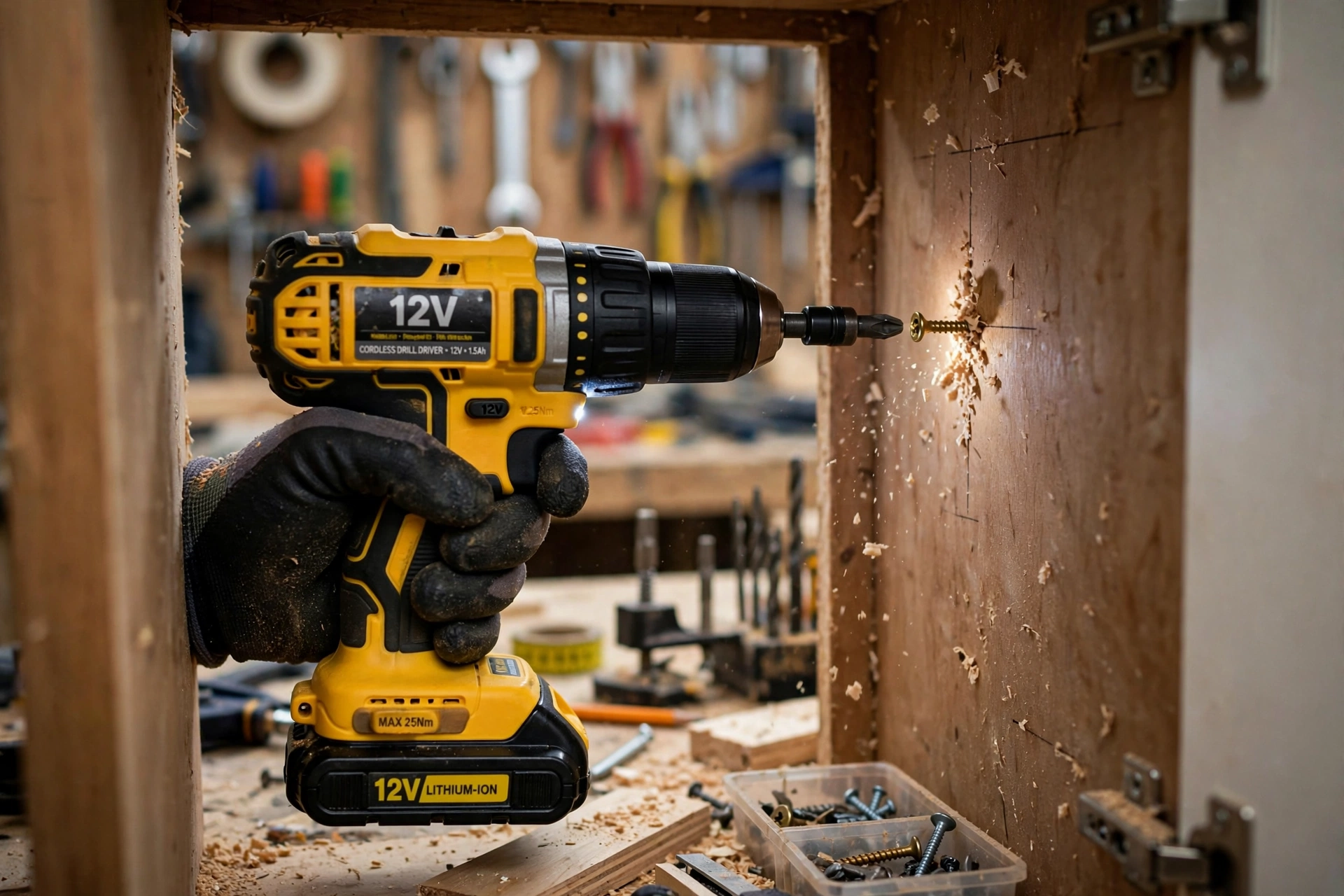
12V platforms (DeWalt 12V MAX, Milwaukee M12) use smaller battery packs with fewer cells. The practical result: less weight, smaller tool bodies, and lower maximum power output. Neither number tells you everything — motor design, gearing, and battery capacity (amp-hours) matter just as much.
12V Drills: Where They Shine
Subcompact 12V drills are built for access and comfort. Consider the DeWalt DCD701F2 (12V MAX XTREME): it delivers 250 UWO (unit watts out) of power, spins 0–425 / 0–1,500 RPM, and weighs just 1.9 pounds as a bare tool. Its head is only 5.97 inches long, so it fits inside cabinets, between studs, and in other spots where a full-size drill will not go.
Milwaukee’s M12 FUEL 3404-20 takes the same approach further: 400 in-lbs of peak torque, 0–450 / 0–1,550 RPM, a 1/2-inch all-metal chuck, and roughly 6 inches long at about 2.3 pounds. For a 12V tool, that is genuine drilling capability — enough for pilot holes, driving screws, and light masonry work with a hammer-drill variant.
Choose 12V when your work is mostly:
- Driving screws and drilling pilot holes in wood, drywall, and sheet goods
- Working overhead or in tight quarters where every ounce matters
- Doing electrical, HVAC, or cabinetry install work with frequent repositioning
- Building a kit you will carry all day — the whole 12V ecosystem stays light
20V (18V) Drills: Where They Shine
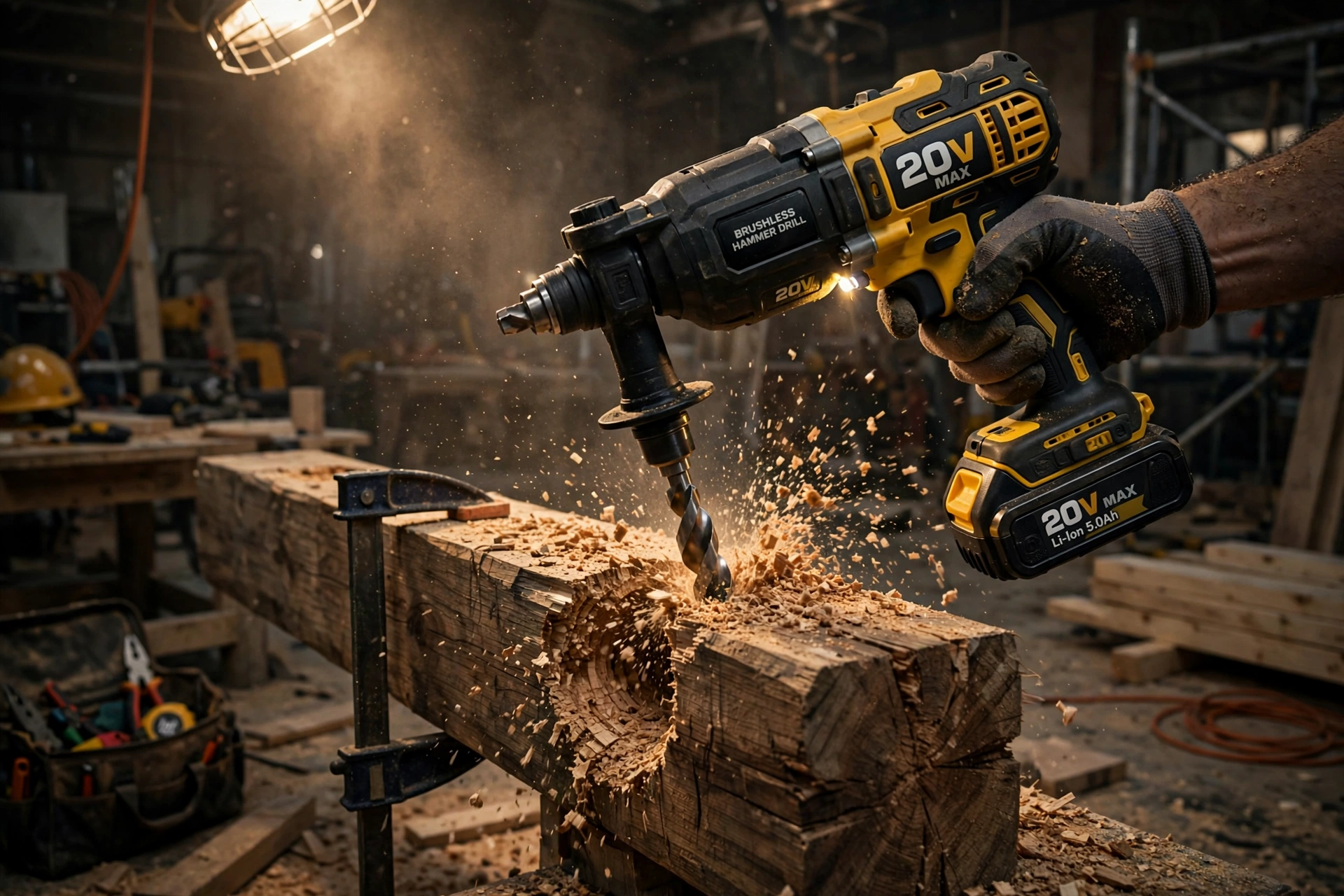
The 18V/20V class is the default choice for general construction and serious DIY. The DeWalt DCD791D2 (20V MAX XR) publishes 460 UWO of power output, a two-speed transmission (0–550 / 0–2,000 RPM), a 1/2-inch metal ratcheting chuck, and 15 clutch settings at 3.4 pounds. That is nearly double the power output of DeWalt’s own 12V flagship.
At the top of the class, Milwaukee’s M18 FUEL 2904-20 hammer drill is rated at 1,400 in-lbs of peak torque with speeds of 0–500 / 0–2,100 RPM and a hammer rate up to 33,000 BPM. Makita’s 18V LXT XPH14Z counters with 1,250 in-lbs of max torque, 0–550 / 0–2,100 RPM, and 0–31,500 BPM. These are the drills that bore large-diameter holes, drive structural screws, and drill into masonry without complaint.
Choose 18V/20V when your work includes:
- Drilling large holes (spade bits, hole saws, augers) in framing lumber
- Driving long structural screws, lag bolts, or deck fasteners
- Masonry drilling with a hammer-drill function
- Anything where you would rather have power in reserve than wish you did
Head-to-Head: Real Specs, Same Brands
| Model | Platform | Power rating | Speed | Chuck | Weight (bare) |
|---|---|---|---|---|---|
| DeWalt DCD701F2 | 12V MAX | 250 UWO | 0–425 / 0–1,500 RPM | 3/8 in. | 1.9 lb |
| Milwaukee 3404-20 | M12 (12V) | 400 in-lbs peak torque | 0–450 / 0–1,550 RPM | 1/2 in. | ~2.3 lb |
| DeWalt DCD791D2 | 20V MAX | 460 UWO | 0–550 / 0–2,000 RPM | 1/2 in. | 3.4 lb |
| Milwaukee 2904-20 | M18 (18V) | 1,400 in-lbs peak torque | 0–500 / 0–2,100 RPM | 1/2 in. | 3.3 lb |
| Makita XPH14Z | 18V LXT | 1,250 in-lbs max torque | 0–550 / 0–2,100 RPM | 1/2 in. | 6.0 lb w/ battery* |
*Makita publishes weight with battery only (6.0 lb); bare-tool weight not published.
A note on comparing UWO vs. in-lbs: DeWalt publishes power as UWO (unit watts out), a combined speed-and-torque output figure, while Milwaukee and Makita publish peak torque in inch-pounds. The two are not directly convertible, which is exactly why cross-brand shopping takes care. Within one brand’s lineup, though, the numbers rank tools consistently.
The Platform Lock-In Is the Real Decision

Here is the part most buying guides bury: the drill is the cheapest part of the decision. Batteries are the expensive part, and they only work within one brand’s voltage platform. A DeWalt 20V MAX battery will never power a Milwaukee M18 tool. Once you own three or four batteries and a charger, switching brands means rebuying all of it.
That is why the common advice — “buy into the platform, not the tool” — exists. Before choosing voltage, look at each brand’s full lineup in that voltage. Milwaukee’s M12 system spans 125+ tools; DeWalt’s 12V MAX line is smaller but covers the essentials; Makita’s 18V LXT is the largest 18V-class ecosystem in the industry. If you see yourself adding a circular saw, reciprocating saw, or oscillating tool later, make sure your chosen platform has good versions of those.
Can You Own Both?
Many experienced users do exactly that: an 18V/20V drill as the primary workhorse, plus a 12V drill for tight spots and quick jobs. The 12V tool gets used far more often than its specs suggest, simply because it is the one within arm’s reach. If the budget allows two platforms, this is a genuinely practical setup rather than an extravagance.
If you must pick one, match the platform to the hardest job you do regularly — not the average job. A 20V drill handles light work fine (just with more weight); a 12V drill cannot fake its way through a job that needs real torque.
Bottom Line
Buy 12V if your work lives in tight spaces, overhead, or all-day carry situations, and your drilling stays in the pilot-hole and screw-driving range. Buy 18V/20V if you drill big holes, drive big fasteners, or want one drill that covers everything. And whichever voltage you choose, commit to the battery platform with the deepest lineup for the other tools you will eventually want.
Still deciding between tool types? Read our guide to impact drivers vs. drills — what is different and when to use each. And once you own the drill, our drill bit types explained guide covers which bits match which jobs. You can also run your numbers through the Drillovia drill finder on our homepage.
3 thoughts on “12V vs 20V Drills: Which Battery Platform Should You Buy Into?”
Comments are closed.