
Disclosure: This post contains affiliate links. If you buy through them, we may earn a commission at no extra cost to you.
Impact wrenches and impact drivers look like cousins, and in a way they are. Both tools use a rotary impact mechanism that delivers bursts of rotational force to drive fasteners with less effort than a standard drill. But they are built for very different jobs. Grab the wrong one and you will either be underpowered or you will destroy the fastener in front of you. This guide breaks down how the two tools differ in drive style, torque, and everyday use cases so you can reach for the right one every time.
What is an impact driver?
An impact driver is a compact, lightweight tool made for driving long screws and threaded fasteners. Its business end is a 1/4-inch hex quick-change chuck that accepts standard hex-shank bits and bit adapters. That quick-change collar makes bit swaps fast, which is why the tool is so popular for deck building, cabinetry, and general fastening work where you cycle through driver bits all day.
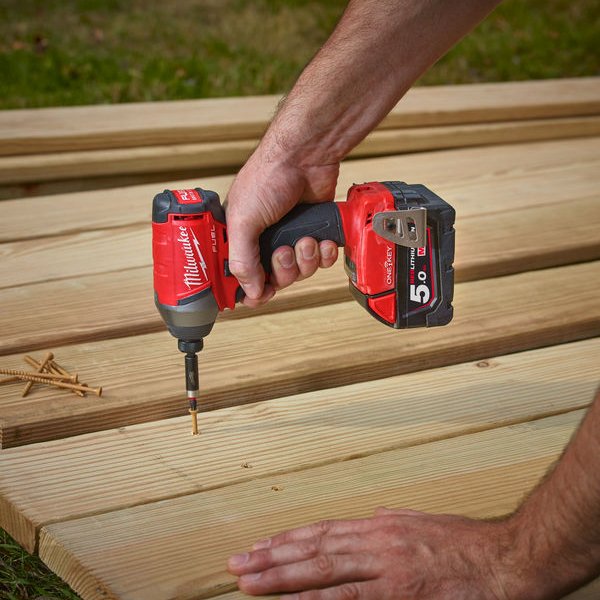
Impact drivers deliver moderate torque, typically in the range of a few hundred inch-pounds on compact 12-volt models and into the low-thousands of inch-pounds on full-size 18-volt models. More importantly, they spin fast, often 2,000 to 3,500 RPM, so they drive long screws quickly without stalling, and the impact action reduces the twisting force you feel in your wrist. If you want the full breakdown of how an impact driver compares with a regular drill, see our guide on the difference between an impact driver and a drill.
Because the 1/4-inch hex chuck accepts bits directly, an impact driver is the natural choice for any job that mostly involves screws: deck boards, subfloor, fence pickets, drywall track, and cabinet screws. It is the screw-driving specialist of the toolbox. Check price on Amazon
What is an impact wrench?
An impact wrench is built for one thing: high torque. Instead of a hex chuck, it uses a square-drive anvil, most commonly 1/2-inch on general-purpose cordless models, with 3/8-inch versions common for tighter work and 3/4-inch or 1-inch drives on heavy industrial tools. You fit impact-rated sockets directly onto the anvil, usually held on by a friction ring or a pin-and-ring retainer.
Torque output is dramatically higher than an impact driver. Mid-torque 1/2-inch cordless impact wrenches typically produce a few hundred foot-pounds of nut-busting torque, and high-torque models push well past 1,000 foot-pounds of breakaway torque. That force is what breaks loose rusted lug nuts, suspension bolts, and large structural fasteners. The trade-off is size and weight: impact wrenches are bulkier, heavier, and harder to control for delicate work.
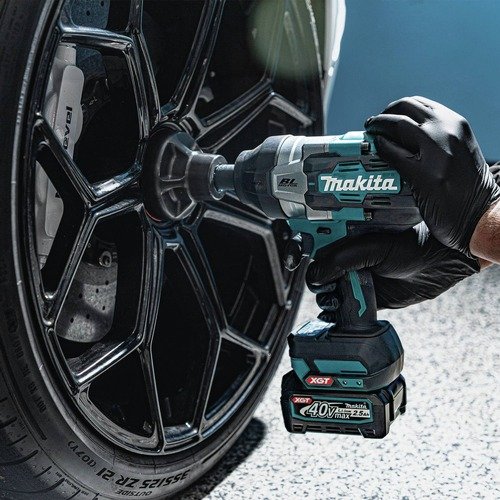
The classic use cases are automotive and mechanical: lug nuts, axle nuts, suspension work, and large machine bolts. In construction they show up for structural timber bolts and heavy equipment maintenance. Check price on Amazon
How the impact mechanisms differ
Both tools use a hammer-and-anvil mechanism, but they are tuned differently. Inside each tool, a motor spins an internal hammer that strikes the anvil repeatedly, adding rotational impacts on top of continuous rotation. That impact action is what drives fasteners without twisting your wrist.
In an impact driver, the mechanism is tuned for speed and a high rate of light-to-medium impacts, which keeps long screws moving without tearing out the drive recess. In an impact wrench, the mechanism is tuned for maximum torque per blow: heavier impacts at lower rotation speed, which is what breaks loose a seized bolt without rounding the head. Think of the impact driver as a rapid-fire approach and the impact wrench as a slower, heavier hammer. Torque gets the headlines, but speed matters too: the driver’s higher RPM makes it pleasant for running dozens of screws, while the wrench’s lower speed gives control on large fasteners.
Torque, drive size, and fastener sizes
The drive size on each tool tells you what fasteners it is meant to handle. The 1/4-inch hex chuck on an impact driver suits screws and small bolts, generally up to about 1/2-inch diameter for lag bolts with a hex-shank socket adapter. The 1/2-inch square drive on an impact wrench is meant for sockets from around 10mm up to 32mm and beyond, covering lug nuts and large structural hardware.
Torque tells the rest of the story. Impact drivers are measured in inch-pounds, with typical full-size cordless models landing between 1,200 and 2,000 inch-pounds of maximum torque: plenty for screws, nowhere near enough for a rusted suspension bolt. Impact wrenches are measured in foot-pounds, with mid-torque models around 300 to 600 foot-pounds and high-torque models reaching four figures. The difference is roughly an order of magnitude, which is why the two tools are not interchangeable for heavy work.
When to use an impact driver
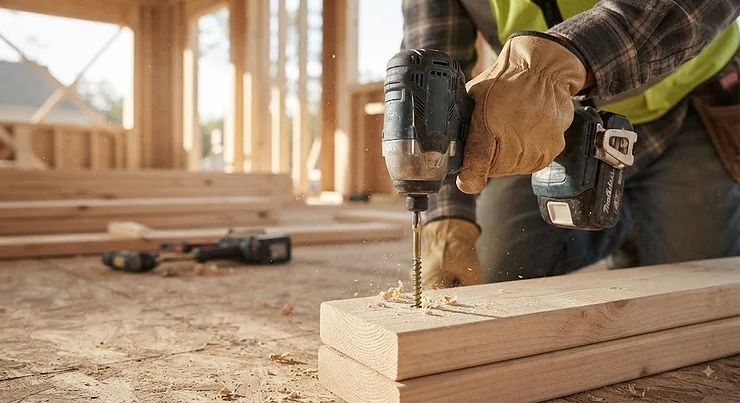
Reach for the impact driver whenever screws dominate the job. Typical tasks include decking and fencing, subfloor and framing screws, cabinet installation, mounting electrical boxes, and assembling flat-pack furniture with long fasteners. Its compact size also makes it the better choice inside cabinets and in other tight spots where an impact wrench simply will not fit.
With a socket adapter, an impact driver can also handle light bolting work: small machine bolts, nuts on threaded rod, and hardware up to roughly 1/2-inch diameter. This versatility is one reason many people own an impact driver before anything else. But adapters have limits, which brings us to safety in the next sections.
When to use an impact wrench
Reach for the impact wrench when torque is the bottleneck. Lug nuts, axle nuts, crank bolts, suspension and steering hardware, large lag bolts in structural timber, and rusted or over-torqued fasteners all fall in this territory. If a breaker bar is what you would reach for by hand, an impact wrench is the powered equivalent.
Impact wrenches also earn their keep in shops where sockets are the main interface. Because the square-drive anvil mates directly with impact sockets, there is no adapter stack robbing you of torque or adding wobble. For repetitive automotive or equipment work, that direct connection is both faster and more reliable.
Can you use one tool for the other job?
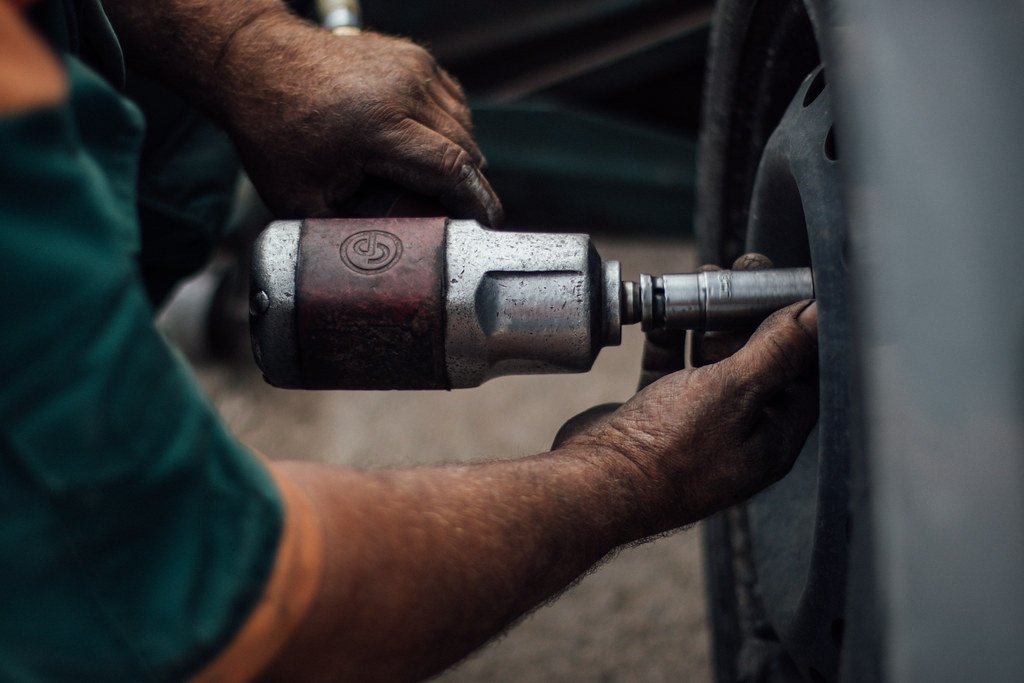
Partly, but with clear limits. An impact wrench can drive screws if you fit a square-to-hex adapter, but it is a poor substitute. The torque is far too high for most screws, the tool is heavy and bulky, and the risk of snapping screw heads or stripping drive recesses is real. It works in a pinch for large structural screws and timber bolts, where the torque is actually welcome.
Going the other direction, an impact driver can remove lug nuts on some vehicles, particularly smaller cars where the nuts are torqued to moderate values and are not corroded. Many people get away with it. But it is not a reliable plan. A rusted or over-torqued lug nut will stall an impact driver, and repeated max-effort attempts shorten the tool’s life. If tire changes and automotive work are regular tasks, the impact wrench is the honest answer.
A note on chucks and bit compatibility
One practical difference is how bits and sockets attach. The impact driver’s 1/4-inch hex quick-change chuck is a convenience feature for bit work, while the impact wrench’s square-drive anvil is a strength feature for socket work. If you are curious how these chuck styles compare with the keyless and keyed chucks found on drills, our guide to drill chuck types covers the full picture.
Socket and adapter safety: use impact-rated accessories
This is the section that saves fingers and finishes. Standard chrome sockets and non-impact adapters are not designed for the hammering action of impact tools. Under impact loading, chrome-vanadium sockets can crack or shatter, sending fragments flying. Always use sockets marked as impact-rated, which are made from tougher steel and have thicker walls to absorb the blows.
The same warning applies to adapters. Hex-shank socket adapters let you run sockets on an impact driver, and square-to-hex adapters let you run bits on an impact wrench. Both are handy, but adapters become the weak link in the chain. Cheap adapters can snap under load, and a long adapter stack reduces the torque that reaches the fastener. Keep adapters short, buy impact-rated versions, and replace any adapter that shows cracks or deformation.
One more caution: never use impact-rated sockets on a tool with a worn or damaged anvil retainer. If sockets slip off the anvil easily, the retaining ring needs attention before you put the tool back to work.
Buying guidance: battery platform, drive size, and torque needs
If you are buying into one of these tools for the first time, start with the battery platform. Cordless impact drivers and impact wrenches are sold as bare tools and as kits, and once you own batteries and a charger for a platform, every additional bare tool on that platform costs less. For most homeowners, the sensible first purchase is an impact driver on the same battery platform as their drill, since screw driving is the most frequent task.
Choose drive size by the work. A 1/4-inch hex impact driver covers screws and light bolting. A 1/2-inch impact wrench covers automotive and heavy mechanical work. A 3/8-inch impact wrench splits the difference and suits people who work on smaller equipment or in tight engine bays. Buying a high-torque 1/2-inch model for occasional lug nuts is fine, but know that it will be heavier and harder to control than a mid-torque model.
Match torque to the task, not the ego. For deck screws and general fastening, any current full-size impact driver has enough torque. For lug nuts, look for an impact wrench whose nut-busting torque comfortably exceeds the torque spec of your vehicle’s lug nuts plus a margin for corrosion. For rust-belt automotive work, more torque is genuinely useful, which is why high-torque models exist.
Impact wrench vs impact driver: side-by-side comparison
| Feature | Impact driver | Impact wrench |
|---|---|---|
| Drive type | 1/4-inch hex quick-change | Square drive (commonly 1/2-inch) |
| Typical torque range | Hundreds to low-thousands of inch-pounds | Hundreds to 1,000+ foot-pounds |
| Typical speed | 2,000 to 3,500 RPM | Lower, torque-focused gearing |
| Best for | Long screws, decking, cabinetry, light bolting | Lug nuts, suspension bolts, heavy fasteners |
| Size and weight | Compact and light | Bulkier and heavier |
| Accessories | Hex bits and bit adapters | Impact-rated sockets on the anvil |
| Shop it | Check price on Amazon | Check price on Amazon |
Frequently asked questions
Is an impact wrench stronger than an impact driver?
Yes, by a wide margin. Impact wrenches are measured in foot-pounds and impact drivers in inch-pounds, and a typical 1/2-inch impact wrench produces roughly ten times the torque of a typical impact driver. That is why impact wrenches handle lug nuts and seized bolts while impact drivers handle screws.
Can an impact driver remove lug nuts?
Sometimes, but not reliably. A full-size impact driver can remove moderately torqued lug nuts on smaller vehicles, especially with a socket adapter. Corroded, over-torqued, or large-truck lug nuts will usually stall it. For regular tire work, an impact wrench is the right tool.
Can I use regular sockets on an impact wrench?
You should not. Standard chrome sockets can crack or shatter under impact loading. Use sockets labeled as impact-rated, which use tougher steel and thicker walls designed for the hammering action.
Do I need both tools?
It depends on your work. If you mostly drive screws and do light DIY, an impact driver alone is enough. If you also do automotive work or regularly deal with large, rusted fasteners, adding an impact wrench earns its place quickly. Many workshops end up with both because neither one does the other’s job well.